You must be signed in to view this content. You may need to provide more information to get access to our library.
Id: 257
Type: Conference paper
Published: 01/16/2014
Event: AAS Space Flight Mechanics Conference 2014
Authors:
Click an author to filter the list of related assets below.
Abstract:
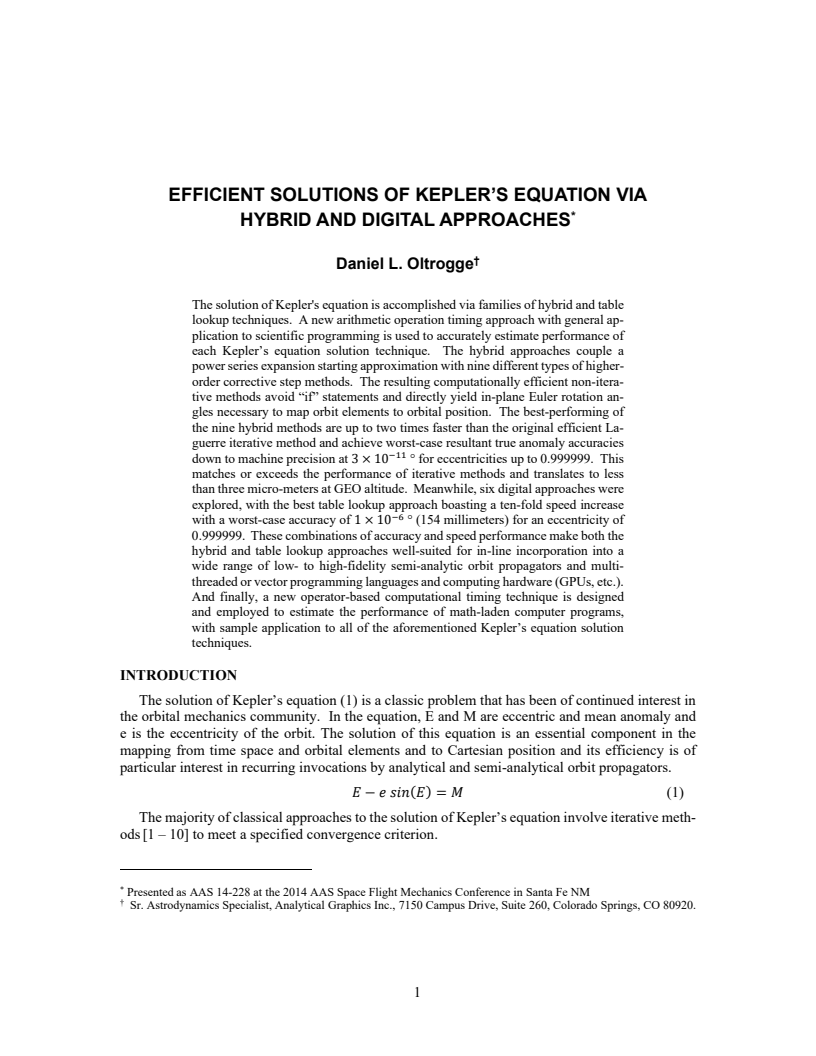
The solution of Kepler's equation is accomplished via families of hybrid and digital techniques. The hybrid approaches couple a power series expansion starting approximation with nine different types of higher-order corrective step methods. The resulting computationally efficient non-iterative methods avoid “if” statements and directly yield in-plane Euler rotation angles necessary to map orbit elements to orbital position. The best-performing of the nine hybrid methods are up to two times faster than the original efficient Laguerre iterative method and achieve worst-case resultant true anomaly accuracies down to machine precision at 3×10^(-11) ° for eccentricities up to 0.999999. This matches or exceeds the performance of iterative methods and translates to less than three micro-meters at GEO altitude. Meanwhile, six digital approaches were explored, with the best digital approach boasting a ten-fold speed increase with a worst-case accuracy of 1×10^(-6) ° (154 millimeters) for an eccentricity of 0.999999. These combinations of accuracy and speed performance make both the hybrid and digital approaches well-suited for in-line incorporation into a wide range of low- to high-fidelity semi-analytic orbit propagators and multi-threaded or vector programming languages and computing hardware (GPUs, etc.).
Keywords:
Click a keyword to filter the list of related assets below.
Citation:
Oltrogge, D.L., “Efficient Solutions of Kepler’s Equation Via Hybrid and Digital Approaches,” Paper AAS 14-228, AAS Space Flight Mechanics Conference, Santa Fe, NM, 16 January 2014, accessible at https://comspoc.com/Resources/Content/Private/C-20220424T071722/Paper/AAS%2014-228_Efficient_Keplers_Soln_Oltroggeg_FINAL_PROOF_Version_FIXED.pdf.
Papers with related authors:
A Critical Assessment of Space Data Message Standards and Their Application to Space Force and Partner Missions