Abstract:
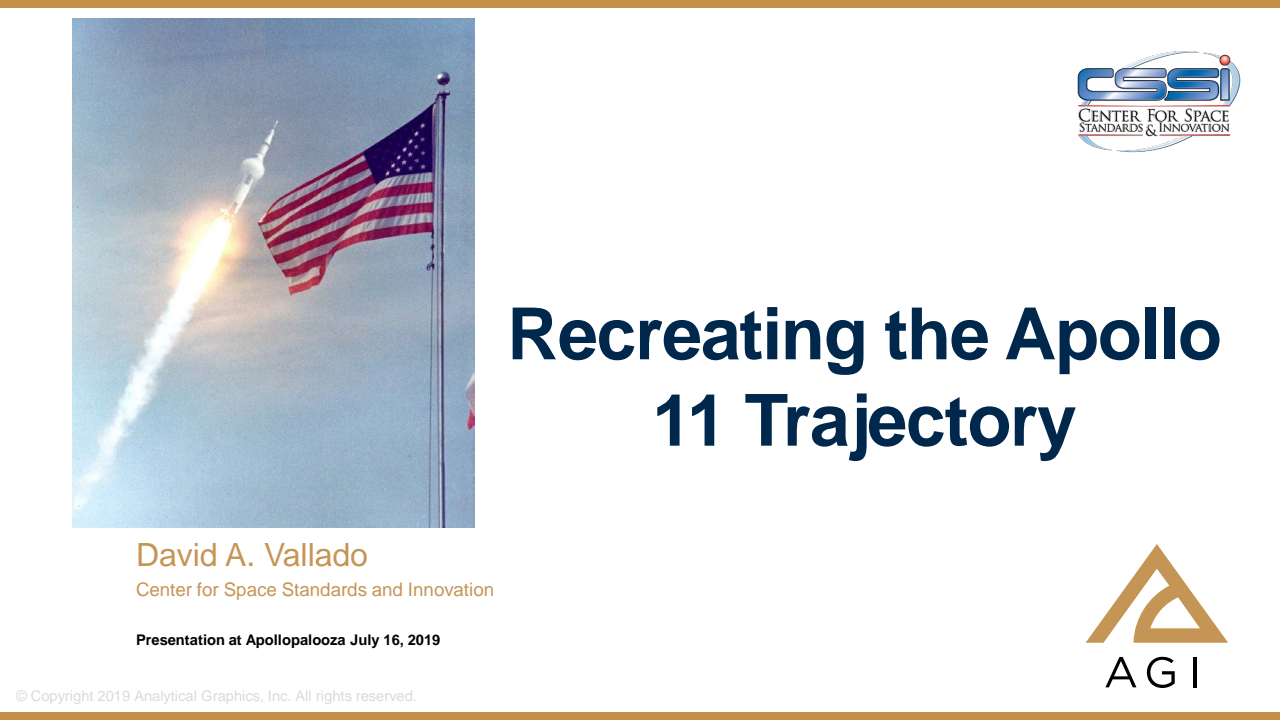
The Apollo 11 mission trajectory can be reconstructed in detail from launch through lunar landing, ascent, return, and splashdown using astrodynamics simulation tools such as the Systems ToolKit (STK) Astrogator environment. Realistic timing, vehicle states, and maneuver sequences are reproduced by integrating historical records, mission reports, and astronaut accounts. The reconstruction models key phases including Earth-orbit insertion, trans-lunar injection, mid-course corrections, lunar-orbit insertion, powered descent, lunar ascent, rendezvous, and trans-Earth injection. Achieving accurate replication requires resolving incomplete or ambiguous historical data, reconstructing thrust profiles, and validating lighting, terrain, and star-field conditions. The resulting simulation illustrates the navigational complexity of Apollo-era missions, the sensitivity of translunar and lunar-descent operations to precise maneuver execution, and the operational challenges encountered during descent, including onboard computer overloads and manual control inputs. Modern astrodynamics tools are shown to be capable of faithfully reproducing the Apollo 11 trajectory and providing additional insight into mission design and execution.
Keywords:
Click a keyword to filter the list of related assets below.
Vallado, D.A., "Recreating the Apollo 11 trajectory," Apollopalooza, Washington D.C., 16 July 2019, accessible at https://comspoc.com/Resources/Content/Private/C-20220425T175746/Presentation/Apollo%20Presentation%20Jul%202019%20final.pdf.