You must be signed in to view this content. You may need to provide more information to get access to our library.
Id: 280
Type: Peer-reviewed article
Published: 04/17/2019
Event: Hypervelocity Impact Symposium 2019
Authors:
Click an author to filter the list of related assets below.
Abstract:
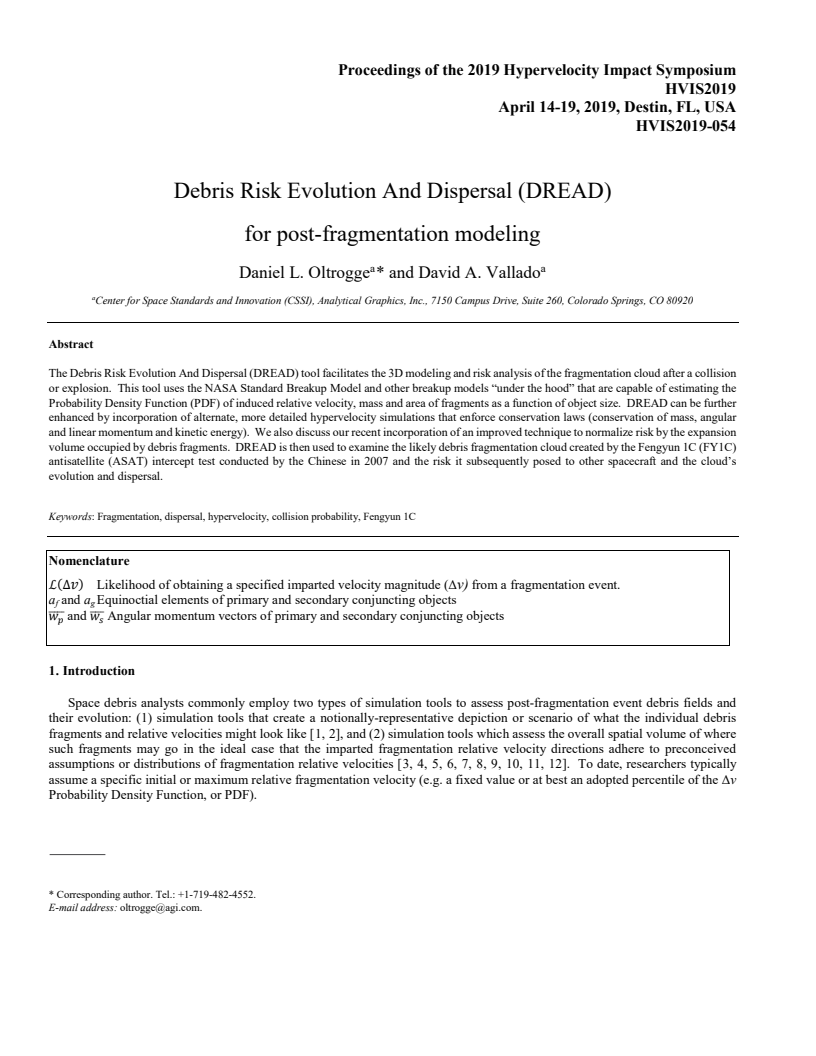
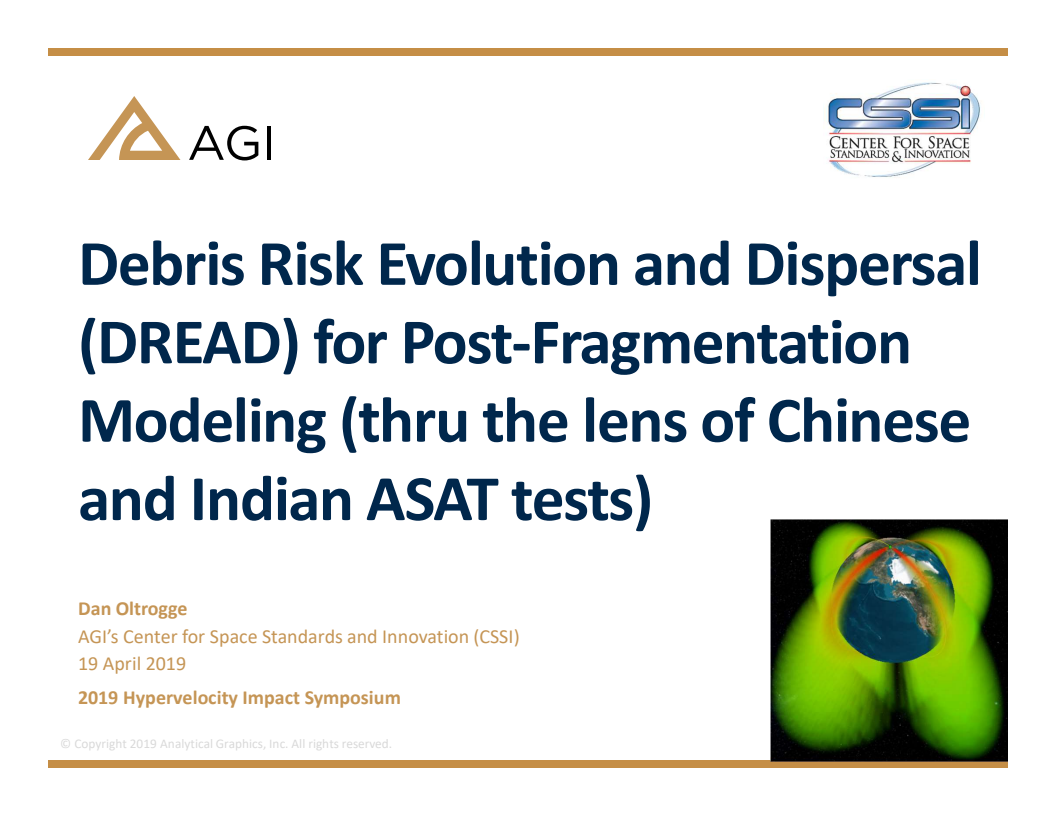
The Debris Risk Evolution And Dispersal (DREAD) tool facilitates the 3D modeling and risk analysis of the fragmentation cloud after a collision or explosion. This tool uses the NASA Standard Breakup Model and other breakup models “under the hood” that are capable of estimating the Probability Density Function (PDF) of induced relative velocity, mass and area of fragments as a function of object size. DREAD can be further enhanced by incorporation of alternate, more detailed hypervelocity simulations that enforce conservation laws (conservation of mass, angular and linear momentum and kinetic energy). We also discuss our recent incorporation of an improved technique to normalize risk by the expansion volume occupied by debris fragments. DREAD is then used to examine the likely debris fragmentation cloud created by the Fengyun 1C (FY1C) antisatellite (ASAT) intercept test conducted by the Chinese in 2007 and the risk it subsequently posed to other spacecraft and the cloud’s evolution and dispersal.
Keywords:
Click a keyword to filter the list of related assets below.
Citation:
Oltrogge, D.L. and Vallado, D.A., “Debris Risk Evolution And Dispersal (DREAD) for Post-fragmentation Modeling,” 2019 Hypervelocity Impact Symposium, Destin, FL, USA, 14-19 April 2019, accessible at https://comspoc.com/Resources/Content/Private/C-20220424T142719/Paper/FINAL_9thaosfst_OltroggeDan_Vallado_David_v20.pdf.
Papers with related authors:
A Critical Assessment of Space Data Message Standards and Their Application to Space Force and Partner Missions